Thursday, February 12, 2009

The Eyes of Wellness Outsider Art Calendar (Free Download)


The Northeast Center for Special Care has once again taken great strides towards raising awareness and building understanding about brain injury, by publishing an online downloadable calendar of survivors' artwork.  This 12-month calendar composed of outsider art is designed to resemble the "Mandela," a Sanskrit symbol of spirituality and wellness.    

The first day of each month the Northeast Center will post a downloadable new calendar page with artwork and a brief description of the artists themselves.  Artwork from the Northeast Center has been featured in publications such as New York Times and Spirituality and Health Magazine, as well as being featured in the documentary, Changing Identities: A Story of Traumatic Injury and Art.  

I highly recommend downloading this calendar.  Not only is the artwork beautiful, but it is a wonderful way of learning more about outsider art and the artists behind it.  http://art-calendar.northeastcenter.com/
 

Wednesday, February 11, 2009

Where Is My Mind (Computer problems part II)


“I need my checkbook!  I need to go back to the apartment, but they’ve torn up the floor, and knocked down the walls.  I don’t have my keys.  Where are my keys?  I need to get my checkbook!”  The distraught woman looked pleadingly at me, tiny her huge wheelchair. 

“Why do you need your checkbook?  The dance doesn’t cost any money – just come dancing with us.  It will be a lot of fun.”

“But I need my checkbook, I owe him $100!”

 “Don’t worry; it’s all taken care of.  I just paid him back.  You don’t owe anything, I’m paying for you.”

“Does he know?  Did you tell him?”

“Yes, I told him.  Everything is going to be okay.”  I put my hand reassuringly on the woman’s arm.  Comforted, the elderly woman stopped perseverating about phantom debts and lost checkbooks.

“How did you know to do that?”  asked the  girl volunteering with me.  She and a staff member had been trying to talk the woman into coming with us for fifteen minutes.  She had said she loved to dance, and would almost certainly love going, but the woman was trapped in her own world.  Listening to her growing increasingly agitated, I thought back to my own perseveration the previous night, and a light bulb went on.  I knew the situation from an inside perspective; I knew the trick to help others through situations like this:


  • Calmly reassure, explain, and calm them in a light, easy manner
  • Distract and redirect their attention – change the topic, focus , and location
  • Hold their attention until they are fully focused on the new topic


  • I hadn’t known what to expect when I signed up to volunteer for the dance at a retirement community.   When L, the team leader, instructed the volunteers to go bring the residents who wanted to come to the dance I was taken aback.  At all of the other NYCares senior activities the residents had been waiting for us, or the staff wheeled them in.  I was nervous, but interacting with this woman was like an answer to my prayers.  I’d heard TBI compared with early onset Alzheimer’s before, but until that moment, I hadn’t seen parallels other than memory loss.  This would help me fix something that had been bothering me all day. 


    I had woken up feeling much better about the computer situation (especially when I found the T and M keys had stopped causing problems – the arrow keys still don’t work).  However I felt terrible about my interaction with J. 


    I hadn’t given him any warning about perseveration or how to handle situations like that.  He had tried his best – everything would make a ‘normal’ girl feel better.   He’d offered to go down and talk to the people at the Mac store, said he’d lend me a computer, and a few other helpful solutions.  However, I wasn’t thinking logically and couldn’t begin to see a way out, let alone appreciate that he was trying to help me.  When approaching the situation from a pragmatic method didn’t work, he had called me to talk. Unfortunately that just made me think about it longer and did nothing but upset me further. 


    That morning I wrote him a lengthy email explanation of how to handle me when I get upset or start perseverating.  He wrote back a sweet email saying that he tends to dwell on things too, but distracts himself with prayer.  It was touching that he tried to understand where I was coming from, but only served to show me how poorly I had explained myself. 


    I attempted to clarify that in cases of perseveration, it is impossible to distract oneself without at least some degree of external assistance.  My interaction trying to get the woman in the retirement community to come dancing with us affirmed this belief.  It also gave me an excellent way to relate the problem to J in more relatable terms. 


    If you look at it right, it’s great having a girlfriend with a brain injury – survivors are suggestible.  If we get frustrated, emotional, angry, or anything negative all you have to do is calmly redirect our attention and we’re happy again.  What man wouldn’t want a girlfriend like that? (Believe me, reading “brain injured patients are suggestible” still annoys me a bit, but it is good to know your strengths and weaknesses.)


    Thrilled that I had learned a new method of explaining perseveration, my night only got better from there.  I had been skeptical when the team leader instructed us to move the residents in wheelchairs around the dance floor in time with the music.  I envisioned elevator music, bored residents, and volunteers enduring the tedium out of the goodness of their hearts.  I couldn’t have been more wrong.


    “M will keep you dancing all night,” L said as he paired me up with the petite African American woman with sparkling eyes. Big band, rock and roll, salsa … it was a mix of upbeat music from every decade.  L and several other volunteers (excellent dancers) would periodically “dance” with the residents, or do impressive swing exhibitions with one another.   Fairly bursting with energy, my wheelchair-bound partner swung her arms in time to the music as I wheeled and spun the chair. 


     L hadn't been kidding, M would have danced all night if we’d let her.  The hours flew by, and we were all a little sad when the music stopped.  Taking M back to her room, she told me about how while she was growing up her mother encouraged her to dance.   “My aunts were against it, but my mother always told me to dance while I could.  I love it to this day,”  she told me with a broad grin.


    I left the retirement community energized and excited.  “I want to learn how to dance now!” I texted J.   I hope that I am as fun-loving and quick-witted as M when I am her age.  Does her love of dance and movement help keep her mind sharp?  The Feldenkrais method is based on body awareness, and in New York, all library books on the subject are housed in the dance section of the Performing Arts Library.  I wonder….

    Monday, February 9, 2009

    I've Gotta Make Like Elvis Costello and Get Happy! (Computer problems part I)


    It was still dark when I awoke, drenched in sweat, gasping for air.  I reached for my cell –  5:30 – not again, I groaned.  Flinging the covers off I rolled out of bed to do damage control. 


    Giving the radiator a dark look, I kicked myself for forgetting to leave the window open.  Flipping the light switch I flung the dripping window wide and tried to shoo the thick cloud of steam out, and surveyed my room, the sauna. Both mirrors fogged over, the walls dripping with condensation, it looked like I’d just taken a shower.  When I looked over at my MacBook, my heart leapt to my throat.  The laptop was covered with water droplets.

    My Macbook is 10 months old, still under warranty, but I do not have the best luck with electronics (or warranties for that matter).  Over the past few months it’s been running slower, taking ages to start up, programs have been spontaneously shutting down, part of the plastic started peeling up for no reason, and various other annoyances, but I need my computer, so I put off taking it in.  I may not be great with electronics, but I am decidedly dependant on them, and losing my computer was not a thought I relished.  Now I may not be the most computer savvy person in the world, but I’m pretty sure that a sauna is not the best place to leave a computer.  It may have been having problems before, but with this incident I was more than a little worried that under warranty or not it a) wouldn’t work and b) they’d refuse to fix it.

    Too stressed to sleep I went into the kitchen to make some snickerdoodles, before laying down and trying to slip in another few minutes of rest before my alarm.
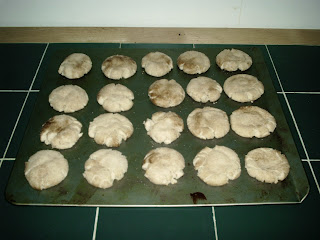
    Snickerdoodles
    Ingredients:

    1 1/2 c Sugar
    1 c. Shortening
    2 Eggs (I use egg replacer)
    1 T. Vanilla
    3 c. Flour
    1/4 t. Salt
    1 t. Baking Soda

    1T Ground Cinnamon
    1/2 c. Flour

    • Preheat Oven to 375
    • Mix cinnamon and 1/2 c. sugar in bowl and set aside
    • Mix shortening, sugar, eggs, and vanilla.  Stir in dry ingredients until well mixed
    • Form dough into balls and roll in cinnamon/sugar mixture
    • Place balls on pan 2-3 in apart and slightly flatten with hand
    • Bake for 8-10 min

    Hours later, down at the library, hoping against hope, I took my computer out, and turned it on with crossed fingers.  It started up alright, maybe….Things did not look promising when I turned the computer.  Steam had gotten under the screen, and one corner just looked wrong.  But maybe….

    Then I started typing.  The “t,” “m,” and “arrow” keys didn’t work.  

    Hours later, down at the library, hoping against hope, I took my computer out and turned it on (being careful to keep my fingers crossed).  My heart caught as the screen flickered on; steam had gotten under it and one corner just looked wrong.  Maybe it would still work though ... if that was all that was wrong, maybe I could live with it....  

    Then I started typing.  The "t," "m," and "arrow" keys were all sticking.  I couldn't write like that.


    With a sinking feeling I put away my notebook and headed to the Mac store.  Why did this have to happen now?  Right when things were moving forward so well.  It felt as if I had the wind knocked out of me.  I was lost without my computer – I couldn’t blog, give advice, network, volunteer, keep in touch with friends or anything even my schedule was online!  Maybe they could fix it there though, they did just give me a new ipod when my last one broke.  I wasn’t happy about losing a day of work it could be worse.  Mac’s known for their great warranty – they’ll fix it and make it all better.

    The “geniuses” at the Mac store took a look at it – corrosion was causing all the problems I’d been experiencing.  It would be $800 to fix.  I was gutted.  The computer wasn’t even a year old, it’s not like this was my fault.  But I was too tired to argue.  I took it home to transfer the last two weeks’ work on my external hard drive. 

    I turned opened the book and was greeted with a strange looking circle in three sections.  What was with Mac and their cute icons!?  Was this their version of a biohazard symbol or something?   I had lost two (productive) weeks of work, would have to get them to fix the computer, and knowing my luck, would probably have to replace it again in two months.  I couldn’t live without a computer for the week they’d told me it would take to fix it. 

    Growing more panicked by the second, I called J for support and to see if maybe he had an extra laptop I could borrow in the meantime.   No answer.  I left a tearful message apologizing for bothering him at work and telling him the situation.  Okay, I was on my own, I took a deep breath, put my external hard drive in my computer bag along with the Mac and headed back to the store.  Maybe they could rescue the files.

    When I got the computer back to the Mac store I found my answer.  Turned out their geniuses hadn’t taken my computer out of target disc mode.  They helped save the files, and I went back to the library to see if I could get any work done, or at the very least find a plane ticket out of the country while they fixed my computer.

    Taking the computer apart and putting it together again had fixed some problems, but the “arrow” and “m” keys still didn’t work.  I had saved the files, most of the keys worked, but I wasn’t any further from tears.  Like a broken record, my mind kept going back to the dull, beaten feeling that it had happened again – right when I needed it most a piece of technology it had broken.  Again.   I had to take care of everything by myself.  Again.  In my mind the world piled sandbag after sandbag of unfairness on my shoulders weighing me down, and each new insult added to the prodigious weight.

    That evening at the meeting, J tried to hug me, and I took a reflexive step back, “I will cry if you hug me.  Do not be nice to me.” I told him.  It was true, when I am upset I can keep a brave face if I have someone or something to rally against, but if people are nice to me, it’s too much.   And I did not want any part of crying in public.


    Poor J couldn’t understand it.  He apologized trying to understand why I was so upset and tried his best to understand.   He hadn’t gotten my message until ten minutes before.  Why was I so upset?  Was it the money?  Was it that he hadn’t called me back?  Was it the time?  But his look told me he thought I blamed him.

    “No, it’s not that.  Don’t worry it’s nothing to do with you,” I told him.  Some part of me knew I was being silly, but I couldn’t see the bright side to save my life.  My mind just kept coming back the negatives of the emotion-fraught day.  I just wanted to go home and mope, sinking into a self-pitying slump.  

    Depression is one of the most common psychiatric complications in brain injury.  I am thankfully not depressed, but when I am fatigued, the stresses, and complications in life can become overwhelming.  Being faced with losing my computer was a huge deal.  That combined with lack of sleep the night before, my mind the Mac geniuses telling me the warranty wouldn’t cover it, feeling like I was having to take care of things alone, and my brain replaying the day’s worst highlights on a loop of perseveration was too much.  When J called later, I tried to explain what I was going through, but in a hollow sort of way; I didn’t want to talk on the phone.


    Just as there are numerous factors causing it there are many ways to break free from depression and perseveration’s self-perpetuating loop.  As with many TBI-related traps, is important survivors let their loved ones know about this.  Self-awareness can be extremely difficult, especially at times like this, so their help and guidance can be invaluable. 
    • The number one thing is to make sure you are well rested – a good night’s sleep, or satisfying nap works miracles.  Fatigue is at the root of so many tbi-related problems.  Though we may not like to admit it, survivors do need more sleep, and we pay for it if we don’t get enough.
    • Companionship, human or animal is also extremely therapeutic for me in cases like this
    • In the same vein, human touch also works wonders  Though I pushed J away when he tried to give me a hug, that was solely because I did not want to cry in public.
    • A good cathartic cry is in my experience, an excellent release for tension, stress and way out of the trap.
    • Finally, just as I spoke of in the last entry on agitation, I find that distraction works wonders.  An outside party must assist with this, but distraction, (or if you are caught in an actual depression I find travel works wonders) is a good ace to keep up your sleeve

    However keep in mind, sleep is paramount.  The other three suggestions will no more effective than band aids on a shark bite if you are not well rested.  However they do work as excellent aids to bolster you when sleep isn’t enough….

    Friday, February 6, 2009

    "Be Kind for Everyone You Meet is Fighting a Hard Battle" (W 4th part II)


    I wish that I were sensitive enough to have decided to change my inattentive ways all on my own, but alas this is not the case.  I’m thick – I need to be hit over the head (no pun intended) before I get the message.  And the jarring reminder I got was exactly the wakeup call I needed….


    Waiting for the train, I leaned against one of the faded hunter green pillars, my nose buried in the Elephant Vanishes.   Every page or so I would look up to peer into the cavernous black tunnel, straining my eyes for the faintest hint of headlights, or breath of air from an approaching train.  No luck.  Cursing the MTA, I would go back to trying to concentrate on my book.


    After fifteen minutes a slurred bellow interrupted my reverie, “Geeeve me ah dolla foh shum foood.”

    Startled, I jerked up from the book to see a massive figure sporting a worn leather jacket, over what looked like a bundle of grimy, torn clothing. The formidable man lumbered towards me, thick-fingered hand outstretched.  From fifteen feet, his stench was bad and it seemed to get exponentially worse with each step.  As he drew near, the rank smell of whiskey and body odor made me take an involuntary step back.

     “Sorry,” I shrugged my shoulders;  “I don’t have a job right now.”

    Even if I’d had money, I wouldn’t have given it to him.  I have a strict policy against giving beggars money (musicians and artists are a different story).  As often as not your dollar won’t be going towards food, and I have no desire to encourage drug use.  I will however, always give them food if I have it, and because of this I try and carry fruit or nutritional bars with me.  If they turn down the food – you can be pretty sure they didn’t need money to fill their stomachs.  But today I just didn’t have any food with me.

     “Yeah, but yoush gotsh food, yoush gots a home, yoush don gotsh problems.”

    Disgusted, and increasingly annoyed, I looked pointedly away.  I was done listening.

    “All high and mighty and can’t even spare a dollar on Martin Luther King Day?  B*tch.  People like you can’t even understand what problems are….”  Volume and ranting increasing as he stumbled away, several other commuters threw glances in his direction. 

    I am beyond thankful that he didn't stop to argue, for his sake as much as mine.  As he denounced me for having an easy life, and being selfish, myopic, and self-absorbed, I could feel my gorge rising.  My fingernails bit into my palms, as I focused on the pain fighting to keep my mind free from the all-consuming grip of building tide of TBI-driven rage.   Telling me I didn't know what problems were, how dare he?  

    Were it not for the rising tide of anger then I would have seen the obvious danger; he was male, twice my size, uninsured, and mentally unbalanced (at the bare minimum).  I should have been able to see the awful circumstance he was in for what it was and felt compassion, pity, or perhaps disgust, rather than rage.  However my anger and outrage corroded all reason, rationality, sense, or thought of self-preservation.   If the man had stayed, and engaged me in a confrontation, rather than ignoring the clearly intoxicated bum, I would have stepped up to the plate and given him a piece of my mind.  

    Happily the train came within a minute, just in the nick of time.  I reflexively stepped into the car, and with the change of settings the anger and outrage dissolved.  The man probably wasn't in a condition to think of anyone's troubles but his own.   Though assumptions and prejudgments are one of my pet peeves I have to remind myself to "be kind, for everyone you meet is fighting a hard battle," and teach rather than react.

    Thankfully today my flashes of rage aren’t as intense, and I have come light years in controlling them, but I do still work to manage living with anger and heightened emotions.  As with most TBI residuals, the doctors’ advice is to stay well rested, keep a regular schedule; avoid stress – the usual suspects.  Unfortunately, these things are not always feasible, and even when they are; anger flashes can rear their ugly head.

    My best advice for times of agitation, (I wish I had known years ago) is to walk away and get yourself out of the situation if you possibly can – change scenery, change topics, but it is paramount to think about something, anything else.  Often this can be all but impossible for me to do alone because perseveration almost always goes hand in hand with my rage and traps me there.  

    This is why it’s imperative to talk to your friends and family about how to handle these situations, for your sake as much as for theirs. Survivors are generally suggestible so the best thing to do is to redirect their attention to another topic, change the surroundings, and the agitation will disappear.   It's almost frightening how well this trick work, and it can be unsettling to onlookers to see such an abrupt change.  For me though, it is a welcome release from the clutches of TBI. 

    I would love to hear your stories about similar situations, and struggles with heightened emotions.  Any input on  tactics for coping with anger flashes would be fantastic too.   I always say, it never hurts to have more TBI-fighting weapons in your arsenal.

    Wednesday, February 4, 2009

    Get Your Head Out of the Clouds (W 4th part I)

    Lengthening my stride, I didn’t look twice as I hurried towards glow of the subway entrance.  My destination was in sight – West 4th.  


    I raced down the cement steps into the welcoming warmth and stopped short at the turnstile.  After a few minutes fumbling in my pockets with unwieldy halfway-frozen fingers, I clumsily extracted my metro card.  


     Ordinarily I like walking through the labyrinthine streets of downtown New York.  It wasn’t that cold of a night, coming back from my friend’s party at Cocoa Bar to the West 4th stop shouldn’t have been a problem, but I wasn’t dressed for it.  In a hurry, I’d left my scarf at home and somewhere during the course of the day I had lost one of my gloves.  Scarfless, gloveless, and wearing a cute dress, I was still frozen solid when I made my way to the C platform to wait for the late night A train.  Lots of people waiting – good – there hadn’t been a train for a while.  One would be coming soon.


    This is the new New York.  Ten years ago a girl like me walking around alone at night in these neighborhoods would have been worse than stupid, or so they tell me.  I missed my opportunity to experience the mean streets of New York by a few years, moving to the city in 2005, but I’ve heard the stories.  We all have.


    It is probably for the best that I did not move to New York “back in the day,” given my unfortunate tendency towards inattentiveness.  This is a symptom common to brain injury, and it has gotten much better over the years.  Today if I concentrate and remind myself then I am perfectly capable of having a keen awareness of my surroundings.  However, this vigilance no longer comes naturally to me, and if I don’t then I may remain blissfully unaware of even the most strident warning bells and whistles.  When I enter a new or potentially dangerous setting, I try to be careful, but staying on guard all the time saps my energy.  


    It's great that I don't have the added stress of living in a war zone like Batman's Gotham City, but unfortunately, dangers don't regulate themselves to sprawling metropolises or foreign situations.  They may be different types, but accidents can just as easily happen on a suburban street, or in your own home.  It is always best to be aware of who is nearby and what is happening around you, because carelessness and inattention can be deadly.  Because of deficits like inattention and poor judgment among others, a survivor is three times more likely to have a second injury and eight times more likely to sustain a third.  As difficult as it can be, it is a good idea to be mindful of your surroundings when you are alone.  If constant vigilance is too much, than at least try to remember to assess your surroundings when you enter a new place, or stay with someone who can help you with this. 


    Three times more likely to sustain a second injury and eight times more likely for a third.  Wow.  


    I know I haven’t always been as careful of this as I should and writing this, has really been wake up call.  While the statistics are still fresh in my mind I'm going to start taking a few extra precautions, be a little more careful and do my part to change those odds….


    Monday, February 2, 2009

    Head Injuries in the Great American Pasttime


    “You can’t call yourself American if don’t watch the Superbowl,” my cousin says.  He’s joking, but there’s some truth in it.  Of the top twenty highest-rated television programs, eighteen have been super bowls.  Companies vie for opportunity to get their best, most memorable, exciting ads in what is unquestionably the most expensive advertising slot on television.  Across the country “Superbowl Sunday” is the most celebrated and lucritive yearly sporting event – it is almost a national holiday.


    I can’t call myself an American.  I’ve never seen a football game in my life, much less the superbowl.  Friends have urged me to give it a chance, alleging the plays are as intricate as a chess game, and that it is fascinating once you understand it.  I don’t buy it.  It’s good to get out, exercise, and have fun, but sitting at home, eating junk food, and watching large men in spandex tackle each other has never stuck my fancy.   This year I went from being passively disinterested, and slightly amused to actively horrified at the sport.


    As a rule I won’t pay much attention to articles football, but over the past few weeks the red flag words "brain injury" caught my eye. “New Sign of Brain Damage in N.F.L.,” “Link between Football Injury and Brain Damage,” “Teen Football Players Still Dying, Experts Say Better Safety Measures Needed”….


    In publications ranging from the New York Times to Fox News, I stumbled across no fewer than ten articles about TBI and football.  This did not seem wholly surprising given the hits players take, maybe articles like these appear every year around this time I thought, and started scanning through them. 


    What I read chilled me to my very bone.  A recent study by Boston University School of Medicine revealed that apparently traumatic brain injury is only a fraction of what players need to worry about.  The far greater danger is from “Chronic Traumatic Encephalophy” (CTE), a rare and progressive condition caused by repetitive head traumas when they are not given (sufficient) time to heal.


    Six former NFL players ages 36-50 were tested for CTE, as part of their post-mortem. (the test can only be administered posthumously).  Every one tested positive.  Even more disturbing is that early signs of the condition appeared in a post-mortem of an 18-year-old high school football player.  

    CTE has many of the same characteristics of TBI,or early onset Alzheimer's.  Symptoms include emotional liability, poor judgment, memory loss, inability to concentrate, problems multitasking, and so forth.  To make things worse, in the later stages it can also lead to dementia in people as early as their 40s. 


    Thankfully this condition is exceedingly rare in the general public, however thismakes these findings all the more chilling.  For me, no amount of money in the world would be worth that risk.  I hope and pray that coaches everywhere are more alert to these dangers, and the symptoms of concussion, and allow their players time for recovery between injuries.  I wish that parents would think twice before allowing their children to play sports rough full-contact sports like football or rugby, and stress the importance of allowing time to heal.   Though children are resilient, the 18-year-old proves beyond a doubt that they are by no means immune.


    Maybe I’m missing something here, but wouldn’t it make sense to avoid a head injury if at all possible?

    (I’m not touching boxing with a ten foot pole.) 


     REPORT: AUTOPSY REVEALS SIXTH NFL PLAYER SUFFERED FROM HEAD TRAUMA-RELATED BRAIN DAMAGE http://sports.espn.go.com/espnmag/story?id=3864380

    Roethlisberger’s Injury Highlights Nerve Center for Head Trauma http://www.nytimes.com/2009/01/02/sports/football/02steelers.html?pagewanted=2&ref=sports

    Tackling Brain Injuries http://www.boston.com/bostonglobe/editorial_opinion/editorials/articles/2009/02/01/tackling_brain_injuries/

    Teen Football Players Still Dying, Experts Say Better Safety Measures Needed http://www.foxnews.com/story/0,2933,485744,00.html

     Super Bowl's big hits bring gruesome injury risk http://www.google.com/hostednews/afp/article/ALeqM5gOA8-zCPBmx8AUJshH9lnd3WV_cg

     As study reveals NFL headache, concussions could cloud Kurt Warner and Ben Roethlisberger http://www.nydailynews.com/sports/football/2009/01/28/2009-01-28_as_study_reveals_nfl_headache_concussion.html

    Commentary: Links Between Pro-Football And Brain Injury Seem Obvious http://www.wbur.org/news/2009/82903_20090129.asp

    New Sign of Brain Damage in N.F.L. http://www.nytimes.com/2009/01/28/sports/football/28brain.html?_r=1&ref=health

    Devastating impact http://www.recordnet.com/apps/pbcs.dll/article?AID=/20090112/A_SPORTS09/901120317/-1/A_SPORTS

     Link Confirmed Between Football Injury And Brain Damage http://www.wbur.org/news/2009/82882_20090128.asp


    Thursday, January 29, 2009

    Many Hats


    “Without focus you can’t accomplish anything,” or so says my favorite author, Haruki Murakami.  Reading his memoir, What I Talk About When I Talk About Running, I have learned a lot more about him, and a little more about writing.  In he asserts that focus is, after talent, the most important quality for a writer.  I wholeheartedly agree. 
    Unfortunately, TBI destroyed my ability to stay focused and concentrate, not surprising as this is one of the most common symptoms of TBI.  There has been marked improvement over the years, but distractibility and a maddening inability to think in a straight line shadows my every move.  If I am even slightly tired, stressed, or have anything on my mind, my attention span rivals that of a guppy, and I can bid my productivity farewell.  To counter this my doctor prescribes Adderall for me which counters a vast majority of the problems.  However, even with the drug, my mind still wanders on its way to the writing “zone.”
    I adore writing; the solitude, creativity, productivity.  There is nothing quite like breathing life into a story.  Though getting there can take me a while, but once I arrive and click into that focused mindset I can breathe a sigh of relief.  It feels so right, as if I’m where I’m supposed to be.  There I see the world differently, the surroundings barely register, and I finally I work without distraction.

     Writing is unquestionably one of my passions.  I wouldn’t think twice about spending months holed-up working on a book.  However, I wear many hats, both literally and figuratively, I need diversity in my life.  Because of this, though a large part of me finds the isolation, peace, and quiet to be rejuvenating, I do reach a breaking point. When this happens, I exchange my somber writer’s beret for a festive party hat and plunge into the social sphere to concentrate my energies on networking.

     “You can really work a room,” my friend, A always compliments me.  She’s right, throw me in a networking-friendly situation, whether or not I know anyone at the start, I will move around the room and meet people.  By the end of the gathering, nine times out of ten, I’ll have a fistful of business cards and phone numbers.

    For many, these interests would compliment one another swimmingly.  Many people are quite proficient at moving from one vastly different subject to another.  I’ve seen one friend switch from Norwegian to English without missing a beat, another who moves seamlessly from physics problem sets to working on films without batting an eye; the examples are endless.  However none of these people, I think, have brain injuries. 

    With the characteristic distractibility and short attention span it should follow that switching focus would be a cake walk.  Alas, it is quite the reverse.  As with many TBI survivors, though finding focus is a struggle, once I have locked into one task then it’s a concerted effort to switch gears.

    Sadly, rather than complimenting my writing, I find that moving between the vastly different networking and writing to be draining.  I end up wasting more time than I should refocusing, need enormous amounts of sleep, and fatigue is never far away.  I have tried to alternate days - one day for networking, and one for writing, but this has not worked as well as I would have liked.  As so often happens, I think what I need to do is just bite the bullet, put in the (enormous amounts of) extra effort, and push through.  Try, try, and try again until I find out what works, until I have  pounded down the new pathways in my brain and sanded the edges smooth.  The tried and true trial and error is my fall back plan.  I will find a way to balance the two, and just maybe this will help make segues and changing hats easier on me….