Showing posts with label Coping Strategies. Show all posts

Wednesday, March 4, 2009

Sleepless Nights

Patting blindly along the floor my hand finally found its way to the soft lump of the throw pillow I had tossed out of bed.  Another futile attempt to find that illusive position which would magically allow me to drift peacefully off into dreamland.  I was reconsidering - maybe hugging the pillow was more comfortable.  Anything was worth a shot.  I’d lie on my back, on my stomach, pulled the covers over my head, then kicked them off.  I had curled up around a pillow on my right side, on my left side, with the sleep mask, without the sleep mask – no use.  All this tossing and turning was practically getting a workout. 


Drawing the pillow to me, I rolled into my standard position – curled up on my right side, facing the wall and tried to relax my mind.  It felt weird, it was too hot – I didn’t want the thing near me!  I threw the covers off, hurled the pillow away in disgust.  Wracking my brain for ideas, I finally remembered my eye-pillow.  I had gotten the small lavender-scented buckwheat pillow as a Christmas present years earlier.  I didn’t use it terribly often, but its cool weight generally had a soporific effect and relaxed me into unconsciousness.  Hopefully, I draped the eye-pillow across my face and waited … and waited … and waited … all to no avail.  I couldn’t get comfortable – nothing helped.


It had been hours since I’d woken up.  What time was it, anyway?  4:47, the telephone glowed.  I’d gone to bed around 11, like normal, but somehow I kept waking up around 3.  Third time this week.  All this waking up in the middle of the night was killing me.  I’d get seven or eight hours of alertness before exhaustion would hit again.  It was like living sleep-paycheck to sleep-paycheck.  What was the matter with me?


I blamed it on steam heat, stress, having too many things on my mind … and I truly believed it.  If I were just relaxed things would be fine, I told myself; if my room weren’t a sauna I would sleep like a baby.  Rationalization after rationalization for why I couldn’t sleep a whole night through….


A week or so later I was having coffee with B, a fellow TBI survivor.   She told me that she participated in some studies Mount Sinai was doing on traumatic brain injury to make a little extra money.  “I think they’re starting one on sleep disorders in TBI survivors next month.  Do you have problems sleeping?  I think they are looking for more survivors to participate.”


As so often happens, my mind erased the problems I’d been having, and I was quick to decline.  “Thanks, but I usually sleep fine.  I’ve been having some issues, but that’s just because of the steam heat.  It isn’t brain injury-related.” 

A few nights later, as I lay awake at some ungodly hour, it all came flooding back.  There are close ties between brain injury and sleep disorders.  Almost all survivors have problems sleeping.  Disturbances in sleep is even one of the signs you have had a concussion!  The fitful nights, the fatigued days, the irritability – it all fit – my problems sleeping were related to the brain injury.  How could such an obvious connection have escaped me? 


Easy – I wasn’t expecting it.  I hadn’t had problems sleeping for years.  So long, in fact, I had forgotten it was even a symptom of brain injury.  I was used to looking out for certain problems – fatigue, spatial deficits, fine motor problems, and that sort of thing – and had all but forgotten about others.  This kind of carelessness and inflexible thinking (refusing to consider brain injury even a possibility) is awful, because sleep disturbances can be one of the more dangerous problems facing survivors.


One would assume a group of people so prone to fatigue, would have no problems at all falling asleep.  Sadly this is far from the case.  When I am fatigued there is a window of time where I do fall asleep easily – I can sleep pretty much anywhere.  However, if I push myself past this point, then I may lie awake bone-tired, but unable to fall asleep.  Or more often, I will be able to go to sleep, but I will wake up a few hours later, my battery still low.  This can turn into a vicious cycle, sleep disturbance leads to fatigue, which opens the door for all of the other deficits. 


So how can one break out of this cycle?  How can you avoid getting sucked into it?


To get out of the cycle, I find if I become trapped in this type of nightmare, the only way out is to “hit reset.”  I take a relaxing weekend and allow myself to sleep in.  If possible I highly recommend going to the country.  Being around nature is extremely therapeutic and recharges my batteries.  If you can, being around horses is wonderful as well. 


It is important to remember is that sleep medications are not the answer.  Though doctors will often misdiagnose survivors as suffering from insomnia and prescribe them, this will not help normalize sleep cycle patterns. 


To avoid getting sucked in is easier than one might imagine.  Some simple ways are:

-       Keep a Regular Sleep Cycle

-       Get into a Daily Exercise Routine (avoid working out at night)

-       Eat a Balanced Diet

-       Sleep in a Dark, Quiet Area

-       Avoid Caffeine Around Bedtime


As far as suggestions for better sleep habits, there will be some you can follow, but others that are out of your hands. For instance, I live in New York, so blocking out the noise and light isn’t really an option.  But you don’t need to live your life by a book – do what’s right for you!   My best advice is to start slow.  Work the easiest ones into your life first – stop drinking caffeine around bedtime, for instance.  If that doesn’t help, add another one. 


 Sleep is the most important thing for brain injury survivors.  A well-rested survivor can take on the world.  We may need to be a little more careful, but it is definitely possible to get our sleep cycles back on track.  Don’t let fatigue get the upper hand. 


Friday, February 20, 2009

Hindsight is 20/20


“I wonder why you sometimes don't do what you know would help-you've given us several examples: not crying on J's shoulder, not getting enough sleep, not eating enough.”


Often outsiders wonder precisely this about brain injury survivors' actions as this insightful blog reader.  So many problems could just be avoided if survivors would simply listen to what doctors’ advice.  In my case it’s even stranger – I know the right thing to do – why don’t I just take my own advice? 


To ease your mind dear reader, though I do struggle with TBI, and the deficits remain, at this point they are shadows of their former intensity.  For the purposes of this blog however, I am focusing on this aspect of my life to better illustrate these entries in order to help educate, inspire, and offer guidance.  However, because of this I give examples of what I am doing wrong, and point out how to do it right in hopes others can learn from my mistakes.  Even though it may sound like my life is a constant battle, I simply don’t write about the good days because they aren’t informative, interesting, and don’t have much to do with brain injury.  In other words, though I had a delightful Valentine’s day with J, writing about the beautiful roses he gave me, our phenomenal dinner, or any other part of the perfect evening, simply did not seem pertinent.  However had this been the sole reason I would not have found it necessary to devote an entire blog entry in response to this comment.…

The other, more complex reason, is a hallmark characteristic of brain injury - poor judgment. Distracted by excitement, caught up in the moment, or locked in a single-minded “need” to get things done, one can push through, oblivious to the warning signs.  To make things worse, the more fatigued, agitated, or focused a survivor becomes, the harder it is to step back and listen to what your body is telling you until it is too late….

My stubborn nature and drive to always push myself further, beat the odds, and prove my self-sufficiency has served me well in many ways.  I believe it has given me the strength to come as far as I have, and has made me who I am today.  However, there is a time to push forward, and there is a time to listen to what your body is telling you. 

Unfortunately I have not yet mastered the art of recognizing when to say when.  I can and do overextend myself, refuse support (not wanting to be a burden), stay out too late, and generally ignore what my body is telling me.  Curiously, the more I take on, the more energized and invincible I feel.  When I get to this euphoric state and push past the brief “nap threshold,” as I refer to the point when exhaustion washes in, whether it is an emotional meltdown, a TBI episode, or me just getting sick, the outcome is never good.  

After the fact I realize exactly what I should have done, and generally kick myself for it. “Hindsight is 20/20” could practically be my slogan.  However, in the heat of the moment on the other hand, stopping isn’t even an option, and unfortunately, a common problem.
Fortunately it is not an insurmountable one.  Brain injury is a desperately lonely thing. This is, however, a time where you need your friends, family, and support the most. It is extremely important to be open with your family and friends about challenges you face.  An outsider’s perspective and a little common sense go a long way in diffusing the situation before it goes too far. 


It isn’t difficult, all it takes are a few gentle prompting words to guide the survivor towards thinking about the consequences of their actions.  This may take the form of suggesting a nap, recommending you cut down your course load (or not taking on so much) in order to do better at a few things (and giving some examples of what could potentially happen), reminding the survivor they have to get an early start.  This is merely another way suggestibility can be used to guide survivors towards wiser decisions.   So many crises truly are avoidable if the situations are correctly handled.  Calmer days are just around the corner….

Wednesday, February 11, 2009

Where Is My Mind (Computer problems part II)


“I need my checkbook!  I need to go back to the apartment, but they’ve torn up the floor, and knocked down the walls.  I don’t have my keys.  Where are my keys?  I need to get my checkbook!”  The distraught woman looked pleadingly at me, tiny her huge wheelchair. 

“Why do you need your checkbook?  The dance doesn’t cost any money – just come dancing with us.  It will be a lot of fun.”

“But I need my checkbook, I owe him $100!”

 “Don’t worry; it’s all taken care of.  I just paid him back.  You don’t owe anything, I’m paying for you.”

“Does he know?  Did you tell him?”

“Yes, I told him.  Everything is going to be okay.”  I put my hand reassuringly on the woman’s arm.  Comforted, the elderly woman stopped perseverating about phantom debts and lost checkbooks.

“How did you know to do that?”  asked the  girl volunteering with me.  She and a staff member had been trying to talk the woman into coming with us for fifteen minutes.  She had said she loved to dance, and would almost certainly love going, but the woman was trapped in her own world.  Listening to her growing increasingly agitated, I thought back to my own perseveration the previous night, and a light bulb went on.  I knew the situation from an inside perspective; I knew the trick to help others through situations like this:


  • Calmly reassure, explain, and calm them in a light, easy manner
  • Distract and redirect their attention – change the topic, focus , and location
  • Hold their attention until they are fully focused on the new topic


  • I hadn’t known what to expect when I signed up to volunteer for the dance at a retirement community.   When L, the team leader, instructed the volunteers to go bring the residents who wanted to come to the dance I was taken aback.  At all of the other NYCares senior activities the residents had been waiting for us, or the staff wheeled them in.  I was nervous, but interacting with this woman was like an answer to my prayers.  I’d heard TBI compared with early onset Alzheimer’s before, but until that moment, I hadn’t seen parallels other than memory loss.  This would help me fix something that had been bothering me all day. 


    I had woken up feeling much better about the computer situation (especially when I found the T and M keys had stopped causing problems – the arrow keys still don’t work).  However I felt terrible about my interaction with J. 


    I hadn’t given him any warning about perseveration or how to handle situations like that.  He had tried his best – everything would make a ‘normal’ girl feel better.   He’d offered to go down and talk to the people at the Mac store, said he’d lend me a computer, and a few other helpful solutions.  However, I wasn’t thinking logically and couldn’t begin to see a way out, let alone appreciate that he was trying to help me.  When approaching the situation from a pragmatic method didn’t work, he had called me to talk. Unfortunately that just made me think about it longer and did nothing but upset me further. 


    That morning I wrote him a lengthy email explanation of how to handle me when I get upset or start perseverating.  He wrote back a sweet email saying that he tends to dwell on things too, but distracts himself with prayer.  It was touching that he tried to understand where I was coming from, but only served to show me how poorly I had explained myself. 


    I attempted to clarify that in cases of perseveration, it is impossible to distract oneself without at least some degree of external assistance.  My interaction trying to get the woman in the retirement community to come dancing with us affirmed this belief.  It also gave me an excellent way to relate the problem to J in more relatable terms. 


    If you look at it right, it’s great having a girlfriend with a brain injury – survivors are suggestible.  If we get frustrated, emotional, angry, or anything negative all you have to do is calmly redirect our attention and we’re happy again.  What man wouldn’t want a girlfriend like that? (Believe me, reading “brain injured patients are suggestible” still annoys me a bit, but it is good to know your strengths and weaknesses.)


    Thrilled that I had learned a new method of explaining perseveration, my night only got better from there.  I had been skeptical when the team leader instructed us to move the residents in wheelchairs around the dance floor in time with the music.  I envisioned elevator music, bored residents, and volunteers enduring the tedium out of the goodness of their hearts.  I couldn’t have been more wrong.


    “M will keep you dancing all night,” L said as he paired me up with the petite African American woman with sparkling eyes. Big band, rock and roll, salsa … it was a mix of upbeat music from every decade.  L and several other volunteers (excellent dancers) would periodically “dance” with the residents, or do impressive swing exhibitions with one another.   Fairly bursting with energy, my wheelchair-bound partner swung her arms in time to the music as I wheeled and spun the chair. 


     L hadn't been kidding, M would have danced all night if we’d let her.  The hours flew by, and we were all a little sad when the music stopped.  Taking M back to her room, she told me about how while she was growing up her mother encouraged her to dance.   “My aunts were against it, but my mother always told me to dance while I could.  I love it to this day,”  she told me with a broad grin.


    I left the retirement community energized and excited.  “I want to learn how to dance now!” I texted J.   I hope that I am as fun-loving and quick-witted as M when I am her age.  Does her love of dance and movement help keep her mind sharp?  The Feldenkrais method is based on body awareness, and in New York, all library books on the subject are housed in the dance section of the Performing Arts Library.  I wonder….

    Monday, February 9, 2009

    I've Gotta Make Like Elvis Costello and Get Happy! (Computer problems part I)


    It was still dark when I awoke, drenched in sweat, gasping for air.  I reached for my cell –  5:30 – not again, I groaned.  Flinging the covers off I rolled out of bed to do damage control. 


    Giving the radiator a dark look, I kicked myself for forgetting to leave the window open.  Flipping the light switch I flung the dripping window wide and tried to shoo the thick cloud of steam out, and surveyed my room, the sauna. Both mirrors fogged over, the walls dripping with condensation, it looked like I’d just taken a shower.  When I looked over at my MacBook, my heart leapt to my throat.  The laptop was covered with water droplets.

    My Macbook is 10 months old, still under warranty, but I do not have the best luck with electronics (or warranties for that matter).  Over the past few months it’s been running slower, taking ages to start up, programs have been spontaneously shutting down, part of the plastic started peeling up for no reason, and various other annoyances, but I need my computer, so I put off taking it in.  I may not be great with electronics, but I am decidedly dependant on them, and losing my computer was not a thought I relished.  Now I may not be the most computer savvy person in the world, but I’m pretty sure that a sauna is not the best place to leave a computer.  It may have been having problems before, but with this incident I was more than a little worried that under warranty or not it a) wouldn’t work and b) they’d refuse to fix it.

    Too stressed to sleep I went into the kitchen to make some snickerdoodles, before laying down and trying to slip in another few minutes of rest before my alarm.
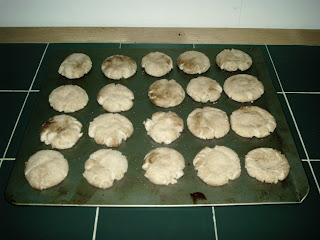
    Snickerdoodles
    Ingredients:

    1 1/2 c Sugar
    1 c. Shortening
    2 Eggs (I use egg replacer)
    1 T. Vanilla
    3 c. Flour
    1/4 t. Salt
    1 t. Baking Soda

    1T Ground Cinnamon
    1/2 c. Flour

    • Preheat Oven to 375
    • Mix cinnamon and 1/2 c. sugar in bowl and set aside
    • Mix shortening, sugar, eggs, and vanilla.  Stir in dry ingredients until well mixed
    • Form dough into balls and roll in cinnamon/sugar mixture
    • Place balls on pan 2-3 in apart and slightly flatten with hand
    • Bake for 8-10 min

    Hours later, down at the library, hoping against hope, I took my computer out, and turned it on with crossed fingers.  It started up alright, maybe….Things did not look promising when I turned the computer.  Steam had gotten under the screen, and one corner just looked wrong.  But maybe….

    Then I started typing.  The “t,” “m,” and “arrow” keys didn’t work.  

    Hours later, down at the library, hoping against hope, I took my computer out and turned it on (being careful to keep my fingers crossed).  My heart caught as the screen flickered on; steam had gotten under it and one corner just looked wrong.  Maybe it would still work though ... if that was all that was wrong, maybe I could live with it....  

    Then I started typing.  The "t," "m," and "arrow" keys were all sticking.  I couldn't write like that.


    With a sinking feeling I put away my notebook and headed to the Mac store.  Why did this have to happen now?  Right when things were moving forward so well.  It felt as if I had the wind knocked out of me.  I was lost without my computer – I couldn’t blog, give advice, network, volunteer, keep in touch with friends or anything even my schedule was online!  Maybe they could fix it there though, they did just give me a new ipod when my last one broke.  I wasn’t happy about losing a day of work it could be worse.  Mac’s known for their great warranty – they’ll fix it and make it all better.

    The “geniuses” at the Mac store took a look at it – corrosion was causing all the problems I’d been experiencing.  It would be $800 to fix.  I was gutted.  The computer wasn’t even a year old, it’s not like this was my fault.  But I was too tired to argue.  I took it home to transfer the last two weeks’ work on my external hard drive. 

    I turned opened the book and was greeted with a strange looking circle in three sections.  What was with Mac and their cute icons!?  Was this their version of a biohazard symbol or something?   I had lost two (productive) weeks of work, would have to get them to fix the computer, and knowing my luck, would probably have to replace it again in two months.  I couldn’t live without a computer for the week they’d told me it would take to fix it. 

    Growing more panicked by the second, I called J for support and to see if maybe he had an extra laptop I could borrow in the meantime.   No answer.  I left a tearful message apologizing for bothering him at work and telling him the situation.  Okay, I was on my own, I took a deep breath, put my external hard drive in my computer bag along with the Mac and headed back to the store.  Maybe they could rescue the files.

    When I got the computer back to the Mac store I found my answer.  Turned out their geniuses hadn’t taken my computer out of target disc mode.  They helped save the files, and I went back to the library to see if I could get any work done, or at the very least find a plane ticket out of the country while they fixed my computer.

    Taking the computer apart and putting it together again had fixed some problems, but the “arrow” and “m” keys still didn’t work.  I had saved the files, most of the keys worked, but I wasn’t any further from tears.  Like a broken record, my mind kept going back to the dull, beaten feeling that it had happened again – right when I needed it most a piece of technology it had broken.  Again.   I had to take care of everything by myself.  Again.  In my mind the world piled sandbag after sandbag of unfairness on my shoulders weighing me down, and each new insult added to the prodigious weight.

    That evening at the meeting, J tried to hug me, and I took a reflexive step back, “I will cry if you hug me.  Do not be nice to me.” I told him.  It was true, when I am upset I can keep a brave face if I have someone or something to rally against, but if people are nice to me, it’s too much.   And I did not want any part of crying in public.


    Poor J couldn’t understand it.  He apologized trying to understand why I was so upset and tried his best to understand.   He hadn’t gotten my message until ten minutes before.  Why was I so upset?  Was it the money?  Was it that he hadn’t called me back?  Was it the time?  But his look told me he thought I blamed him.

    “No, it’s not that.  Don’t worry it’s nothing to do with you,” I told him.  Some part of me knew I was being silly, but I couldn’t see the bright side to save my life.  My mind just kept coming back the negatives of the emotion-fraught day.  I just wanted to go home and mope, sinking into a self-pitying slump.  

    Depression is one of the most common psychiatric complications in brain injury.  I am thankfully not depressed, but when I am fatigued, the stresses, and complications in life can become overwhelming.  Being faced with losing my computer was a huge deal.  That combined with lack of sleep the night before, my mind the Mac geniuses telling me the warranty wouldn’t cover it, feeling like I was having to take care of things alone, and my brain replaying the day’s worst highlights on a loop of perseveration was too much.  When J called later, I tried to explain what I was going through, but in a hollow sort of way; I didn’t want to talk on the phone.


    Just as there are numerous factors causing it there are many ways to break free from depression and perseveration’s self-perpetuating loop.  As with many TBI-related traps, is important survivors let their loved ones know about this.  Self-awareness can be extremely difficult, especially at times like this, so their help and guidance can be invaluable. 
    • The number one thing is to make sure you are well rested – a good night’s sleep, or satisfying nap works miracles.  Fatigue is at the root of so many tbi-related problems.  Though we may not like to admit it, survivors do need more sleep, and we pay for it if we don’t get enough.
    • Companionship, human or animal is also extremely therapeutic for me in cases like this
    • In the same vein, human touch also works wonders  Though I pushed J away when he tried to give me a hug, that was solely because I did not want to cry in public.
    • A good cathartic cry is in my experience, an excellent release for tension, stress and way out of the trap.
    • Finally, just as I spoke of in the last entry on agitation, I find that distraction works wonders.  An outside party must assist with this, but distraction, (or if you are caught in an actual depression I find travel works wonders) is a good ace to keep up your sleeve

    However keep in mind, sleep is paramount.  The other three suggestions will no more effective than band aids on a shark bite if you are not well rested.  However they do work as excellent aids to bolster you when sleep isn’t enough….

    Friday, February 6, 2009

    "Be Kind for Everyone You Meet is Fighting a Hard Battle" (W 4th part II)


    I wish that I were sensitive enough to have decided to change my inattentive ways all on my own, but alas this is not the case.  I’m thick – I need to be hit over the head (no pun intended) before I get the message.  And the jarring reminder I got was exactly the wakeup call I needed….


    Waiting for the train, I leaned against one of the faded hunter green pillars, my nose buried in the Elephant Vanishes.   Every page or so I would look up to peer into the cavernous black tunnel, straining my eyes for the faintest hint of headlights, or breath of air from an approaching train.  No luck.  Cursing the MTA, I would go back to trying to concentrate on my book.


    After fifteen minutes a slurred bellow interrupted my reverie, “Geeeve me ah dolla foh shum foood.”

    Startled, I jerked up from the book to see a massive figure sporting a worn leather jacket, over what looked like a bundle of grimy, torn clothing. The formidable man lumbered towards me, thick-fingered hand outstretched.  From fifteen feet, his stench was bad and it seemed to get exponentially worse with each step.  As he drew near, the rank smell of whiskey and body odor made me take an involuntary step back.

     “Sorry,” I shrugged my shoulders;  “I don’t have a job right now.”

    Even if I’d had money, I wouldn’t have given it to him.  I have a strict policy against giving beggars money (musicians and artists are a different story).  As often as not your dollar won’t be going towards food, and I have no desire to encourage drug use.  I will however, always give them food if I have it, and because of this I try and carry fruit or nutritional bars with me.  If they turn down the food – you can be pretty sure they didn’t need money to fill their stomachs.  But today I just didn’t have any food with me.

     “Yeah, but yoush gotsh food, yoush gots a home, yoush don gotsh problems.”

    Disgusted, and increasingly annoyed, I looked pointedly away.  I was done listening.

    “All high and mighty and can’t even spare a dollar on Martin Luther King Day?  B*tch.  People like you can’t even understand what problems are….”  Volume and ranting increasing as he stumbled away, several other commuters threw glances in his direction. 

    I am beyond thankful that he didn't stop to argue, for his sake as much as mine.  As he denounced me for having an easy life, and being selfish, myopic, and self-absorbed, I could feel my gorge rising.  My fingernails bit into my palms, as I focused on the pain fighting to keep my mind free from the all-consuming grip of building tide of TBI-driven rage.   Telling me I didn't know what problems were, how dare he?  

    Were it not for the rising tide of anger then I would have seen the obvious danger; he was male, twice my size, uninsured, and mentally unbalanced (at the bare minimum).  I should have been able to see the awful circumstance he was in for what it was and felt compassion, pity, or perhaps disgust, rather than rage.  However my anger and outrage corroded all reason, rationality, sense, or thought of self-preservation.   If the man had stayed, and engaged me in a confrontation, rather than ignoring the clearly intoxicated bum, I would have stepped up to the plate and given him a piece of my mind.  

    Happily the train came within a minute, just in the nick of time.  I reflexively stepped into the car, and with the change of settings the anger and outrage dissolved.  The man probably wasn't in a condition to think of anyone's troubles but his own.   Though assumptions and prejudgments are one of my pet peeves I have to remind myself to "be kind, for everyone you meet is fighting a hard battle," and teach rather than react.

    Thankfully today my flashes of rage aren’t as intense, and I have come light years in controlling them, but I do still work to manage living with anger and heightened emotions.  As with most TBI residuals, the doctors’ advice is to stay well rested, keep a regular schedule; avoid stress – the usual suspects.  Unfortunately, these things are not always feasible, and even when they are; anger flashes can rear their ugly head.

    My best advice for times of agitation, (I wish I had known years ago) is to walk away and get yourself out of the situation if you possibly can – change scenery, change topics, but it is paramount to think about something, anything else.  Often this can be all but impossible for me to do alone because perseveration almost always goes hand in hand with my rage and traps me there.  

    This is why it’s imperative to talk to your friends and family about how to handle these situations, for your sake as much as for theirs. Survivors are generally suggestible so the best thing to do is to redirect their attention to another topic, change the surroundings, and the agitation will disappear.   It's almost frightening how well this trick work, and it can be unsettling to onlookers to see such an abrupt change.  For me though, it is a welcome release from the clutches of TBI. 

    I would love to hear your stories about similar situations, and struggles with heightened emotions.  Any input on  tactics for coping with anger flashes would be fantastic too.   I always say, it never hurts to have more TBI-fighting weapons in your arsenal.